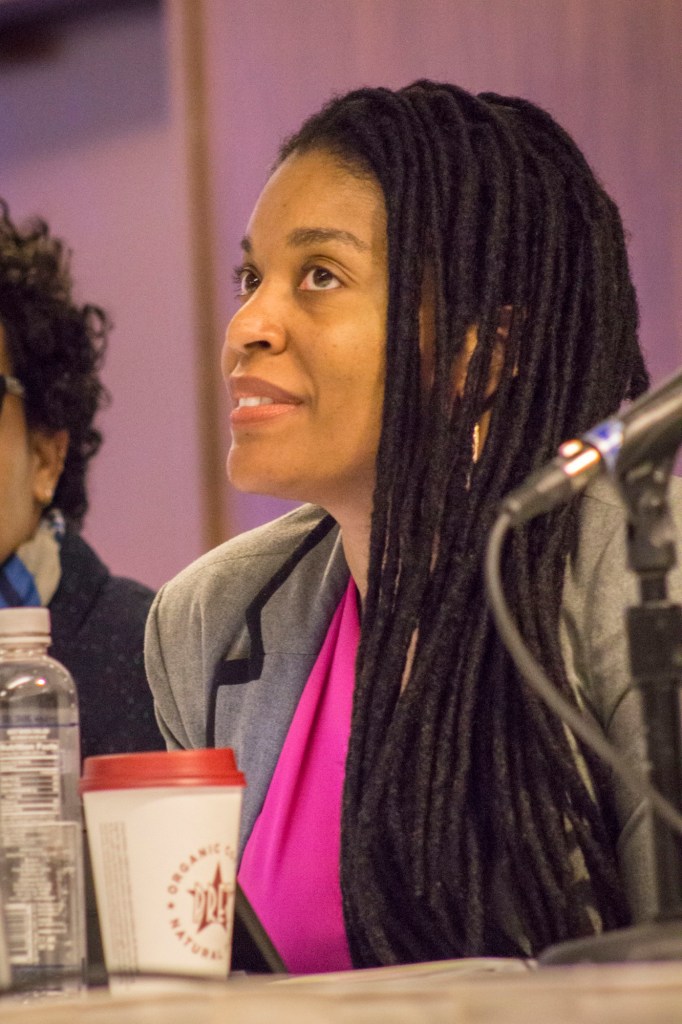
I’m Khalilah Ali and I am a teaching coach & mentor, curricular strategist and interdisciplinary scholar. I have written about expressive culture, new media, and critical pedagogy. I study media and multi-literate identities to advocate for liberatory, humanizing approaches to teaching and learning that honor our students.
To make it plain, I look at how folks use and develop multiple literacies (not just reading and writing, but also visual, digital, cultural, musical, oral, etc.) in relation to media. By multi-literate identities I am referring to how people’s sense of self is shaped by engaging with many different modes of communication, not just traditional print literacy.
My goal isn’t just to describe these literacies, but to argue for educational practices that free learners and educators from oppressive models that don’t fully recognize everyone’s multiliterate identities. Liberatory refers to education that challenges domination and oppression (think Paulo Freire & bell hooks). Humanizing means centering dignity, respect, and affirmation of students’ lived experiences. Too often, schools treat BIPOC, queer, poor or neurodivergent kids’ as deficient or problematic. No! See, our learners’ cultures are rich resources that should be respected and drawn upon in learning spaces not squeezed out of them or diluted.
“I research how we use different forms of literacy through media, and use that research to push for teaching practices that affirm and honor diverse culture rather than treating it as something broken or inferior.”
To that end, I currently am proposing a mixed-methods study on how AI-assisted tools influence HBCU undergraduate students’ learning and metacognitive awareness. Building on that work, I’m expanding my research for secondary humanities educators, focusing on AI-supported lesson planning that integrates graphic novels (e.g., Kindred) and street art as core texts, aligned with social reconstructionist and culturally sustaining aims. Also, my ongoing digital humanities project, Spray Black, Spray Strong, examines the social-justice pedagogy of diasporic Black graffiti artists in Atlanta, Accra, and Bahia. That study directly informs my current curricular research, especially around representation, community accountability, and multimodality. Multimodal curricular access means designing learning experiences that move beyond text-only instruction to engage learners through multiple ways of making meaning—visual, auditory, spatial, kinesthetic, and linguistic. In my curricular work, knowledge is encountered and demonstrated through combinations of reading, writing, discussion, images, sound, movement, digital media, and design. A lesson might pair scholarly readings with short videos, visual mapping, music analysis, collaborative dialogue, or creative production such as podcasts, visual essays, or multimedia presentations. This approach deepens comprehension, supports diverse learning styles, and increases accessibility by allowing students and educators to enter complex ideas through multiple pathways. Multimodal curriculum reflects how people actually learn, communicate, and create meaning in the contemporary world—across classrooms, digital spaces, and community contexts.
“I design curriculum that expands access by engaging learners through multiple modes—text, image, sound, movement, and digital media.”
At Spelman, I also serve as program coordinator for Education Studies. As a secondary methods educator, I partner with pre- and in-service teachers to design UDL-aligned, constructivist, inquiry-rich experiences that are culturally sustaining and anti-racist—expanding access through multiple pathways and digital tools that develop multiliteracies and narrow the digital divide. Beyond campus, I’m a public speaker, podcaster, and rapper-scholar, and I lead FuseArtsHub and InnovatED, initiatives that connect arts and emerging tech for equity.
I earned a B.A. in English Literature and an M.Ed. in English Curriculum & Instruction at Georgia State University, and a Ph.D. in Education Studies at Emory University (Literacy, Pedagogy, and Culture). Before academia, I taught high-school English in urban and suburban districts in the U.S. and abroad, as well as working as a rapper and podcaster—experiences that keep my work grounded in classrooms and communities.
I’m a member of NCTE, ISTE, and AERA, and my work has been supported by Mellon, Fulbright, and Ford fellowships. My publications include chapters in Disrupting Colonial Pedagogies (Illinois), For the Culture: Hip-Hop and the Fight for Social Justice (Michigan), and Yemonja Awakening (Lexington). My book, The Conscious Culture Worker: Counter-Narratives of Black Women Artivists as Educators (Bloomsbury), explores how Black women’s culture work, activism, and education converge.
The Educator’s Educator
 InnovatEd home